A marketing engineer designs and runs the system that does the marketing work: the data it reads, the AI agents that do the tasks, the review gates before anything reaches a customer, and the numbers that show whether it's working.
I'm Cameron LiButti. I spent about five years as a mechanical engineer before I moved into marketing, and I've been in marketing for 13 years since. In March 2026 a podcast host titled our episode "What a Marketing Engineer Knows About Growing Your Practice." I'd never used the phrase about myself. It fit.
Most of what's written about marketing engineers comes from marketers who learned to build with AI, much of it from Profound, the AI search company that made the title popular. That's good work, and I've learned from it. This page comes from the other direction: an engineer who learned marketing, and who now runs an agency on a system he built.
The definition
Marketing engineer definition and origin
A marketing engineer is the person who designs the system behind the marketing and stays accountable for what it produces.
Every campaign, post, page, and report still matters. A marketing engineer spends their time one level down, on the machine that makes them. When the machine is right, the output gets better every week without anyone working harder.
Where the title came from
The job title took off in 2026, when Profound, an AI search company, started hiring for it and other companies followed. The phrase "marketing engineering" is older. Business schools have used it for years to describe models that help marketers make decisions with data.
Why the role showed up in 2026
AI agents made it cheap to build. A marketer who can describe a process clearly can now turn it into working software without waiting on a developer. Marketing teams that used to wait on a developer for every workflow, landing page, integration, or analytics report can now build it themselves. That changed what one person can run, and the job title followed the change.
What "engineer" should mean
In engineering, the title comes with habits. You measure the load before you size the equipment, you write the spec, you set tolerances, and you test the system before it goes into service. Those habits are what make a marketing system safe to run on someone's budget.
The work
What does a marketing engineer do?
01
Measures the load first
When a building owner told me "we need new boilers," my first question was how much boiler they needed. I audited the old system, measured the load, and priced the fix before anyone bought equipment. My first marketing proposal came straight out of that habit. Every client of mine still starts with an audit of what's broken and which fix pays back first.
02
Writes the method down
A method that lives in one person's head can't be handed to an AI agent. At Bidview, our methodology and prompts live in one control plane under version control. When the process changes, the version changes, and every client environment runs on the new rules.
03
Builds the system
This is the part most people picture. Agents in our system draft Google Business Profile posts for about 40 client locations and turn recorded calls into LinkedIn drafts. Others create team tasks and route them to the right person. Each agent is one layer in a model of how the marketing works, and each one runs a workflow the team used to do by hand.
04
Puts review gates in the line
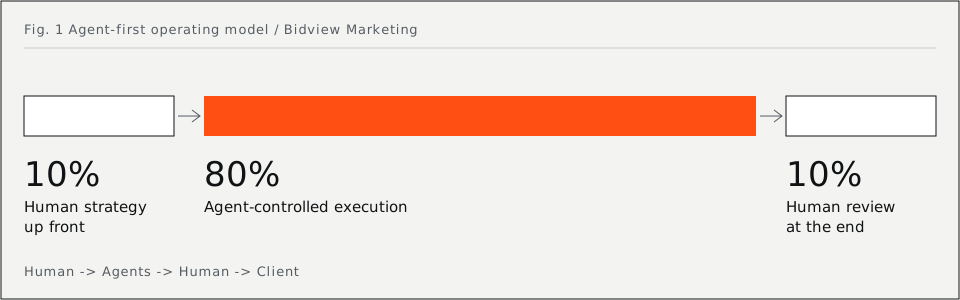
Every job runs on a 10/80/10 split. A person sets the strategy, AI agents do the execution, and a person reviews the work before it reaches a client. In a building, a new system gets inspected before it goes into service. Marketing deserves the same rule.
05
Measures and retunes
A system that can't improve itself falls behind. Ours takes in feedback from the team every week. Since it went live, our account managers handle more than double the clients, and every analysis cycle moved one step faster.
Neighbor roles
Marketing engineer vs marketing ops vs GTM engineer
These titles overlap, and companies use them loosely. Here's how I'd separate them by what each one owns.
Role
What it owns
Typical background
Marketing engineer
The system that produces the marketing: agents, data, rules, review gates, and measures
Marketer who learned to build, or an engineer who learned marketing
Marketing ops
The tools and automations already in place: CRM, email platform, forms, and reporting
Marketing coordinator or admin who went deep on the tools
GTM engineer
The sales side of growth: lead lists, enrichment, routing, and outbound outreach to new customers
Often a former sales development rep
Growth engineer
Product experiments: sign-up flows, onboarding, pricing pages, and in-app tests
Software engineer on a product team
Technical marketing engineer
Explaining a technical product: demos, benchmarks, docs, and technical content
Engineer at a hardware or software company
The short version: marketing ops keeps the current tools running, and a marketing engineer builds the next system. Most small companies need the second one long before they can afford a full team.
The method
The marketing engineering method
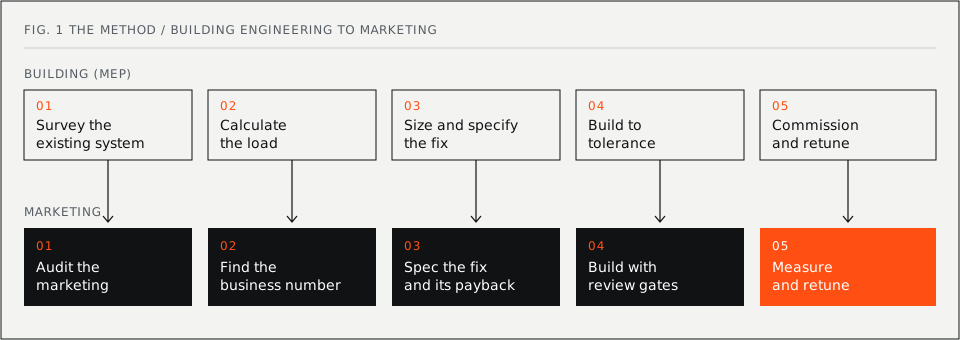
Mechanical, electrical, and plumbing engineers, MEP for short, design the systems inside a building that nobody notices until they fail. I spent my engineering years on the retrofit side: boilers and heating systems for Chicago high-rises and universities built in the 1920s and 1930s. You can't guess on a building that old. You survey what's there before you draw anything.
The same five steps run every marketing system I build.
Step 1: Audit the existing marketing
Before I recommend anything, I look at what's already running: the website, the Google Business Profile, the reviews, and what AI assistants say when someone asks for a recommendation. I also research the market: which local competitors show up, and how each brand is positioned against them. Most businesses already pay for marketing that leaks somewhere. The audit finds where.
Step 2: Find the business number
In a building, the load is how much heat the space needs on the coldest day. In marketing, the load is the business number: how many new clients the owner needs, and what each one is worth. The marketing gets sized to that number, and the metrics follow from it, such as the conversion rate from a visit to a call and the cost of each new customer.
Step 3: Spec the fix and its payback
An engineer doesn't hand a building owner a list of every possible upgrade. They rank the fixes by payback. I do the same with marketing, so the owner knows which change comes first and why. Sometimes the fix is a campaign. Sometimes it's positioning: how the brand describes itself to the audience it wants.
Step 4: Build with review gates
The work gets built as a system of written rules and AI agents. A person checks the output before it reaches a customer. The review gate is the tolerance. It keeps a fast system from shipping a fast mistake.
Step 5: Measure and retune
Engineers commission a new system: they run it under real conditions and adjust it before handing it over. Marketing never stops needing that step. The system reports its metrics and analytics, the team gives feedback, and the rules get updated.
A real build
A marketing engineer's build: the Bidview harness
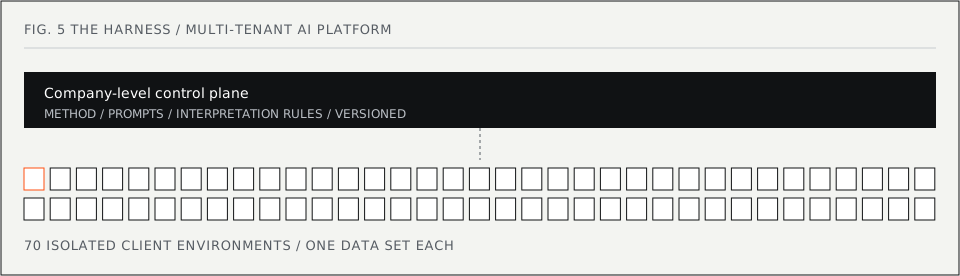
Bidview Marketing runs client work on a system I built. We call it the harness. One company-level control plane holds our methodology and prompts as versioned IP, and 70 isolated client environments run on top of it. Each client's data stays in its own environment.
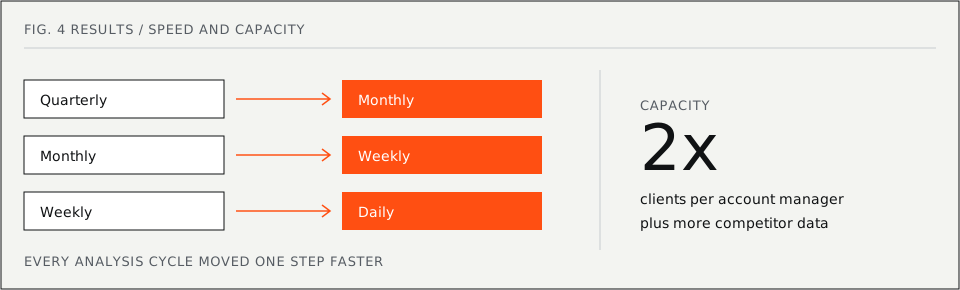
The results show up in capacity and speed. Our account managers handle more than double the clients they used to. Quarterly analysis became monthly, monthly became weekly, and weekly became daily. We also take in more competitor data than before.
70
isolated client environments on one control plane
80%
of execution done by AI agents, with 10% human strategy and 10% human review
2x+
account manager capacity, an increase of more than 100%
~40
client locations with agent-drafted Google Business Profile posts
What failed in the first build
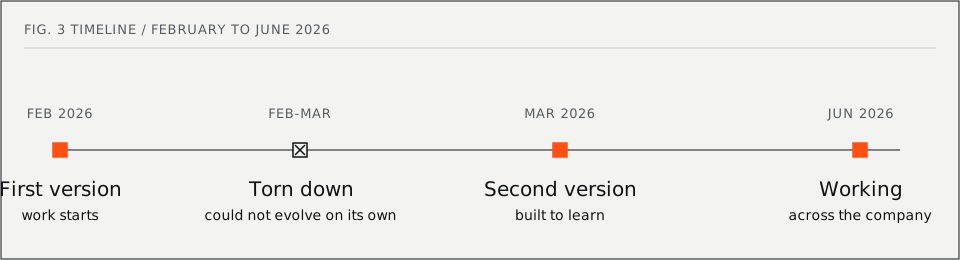
The first version didn't work. I started it in February 2026, and it couldn't evolve on its own. A system that can't learn won't keep up across 70 client environments, so I tore it down. The second version started in March 2026, built to take in the team's feedback every week, and it was working across the company by June.
I'd plan for that in any build. The first version teaches you what the second one needs.
Marketing engineering for local and independent businesses
Most writing about marketing engineers is about software companies with big teams. I work with independent businesses and local professionals: medical, dental, legal, engineering, and solar companies. Bidview has worked with 200+ businesses and manages 170+ locations.
200+
businesses worked with
170+
locations managed
40%
of a tax attorney client's new leads now come from AI
100%
of active clients rank first for AI search visibility against local competitors (DataForSEO, October 2026)
A local owner rarely has a digital marketing team, and a business with one location won't hire a marketing engineer. It can still get the work a marketing engineer does. A tax attorney client of ours now gets 40% of his new leads from AI. His clients ask ChatGPT before they ask a friend. That came from the same method: audit what AI assistants said about him, find the gaps, fix the site and listings, and track where each lead came from. Answer engine optimization, or AEO, is the name for that work: getting a business named in AI answers. For a local business, AEO and local search now sit side by side.
The tax attorney is one case. Across our active clients, every one ranks first for AI search visibility against its local competitors. That's 100% of them, measured by DataForSEO, an independent search data provider, in October 2026.
This is where the system pays off for a small owner. The work that used to need a person per task now runs underneath, and the people on the account spend their time on review and on the client.
Skills
Skills a marketing engineer needs
Systems thinking
Seeing the marketing as one connected system, where a change in one place shows up somewhere else. MEP engineering is about as close to pure systems work as a job gets.
Measurement and attribution
Knowing which number matters for the business, and tracking where each lead came from so the system reports it honestly. Without this, a marketing system gets faster at producing work nobody needed.
Building with AI
Writing a process clearly enough that an agent can do it, then wiring agents to data and to each other. You don't need to be a software engineer. You do need to read what the system did and why. The technology changes every few months, so the skill is learning new automations fast.
Communication
Explaining the system to the people who use it and the customers it serves. Our team talks about the system every week, and that feedback is how it learns.
Marketing judgment
Knowing what good looks like for this business, its brand, and its audience. The system does the volume. The judgment decides what goes in the rules and what gets through the review gate.
Career
How to become a marketing engineer
Qualifications and education
No license or certification exists for this title yet. Most marketing engineers have a marketing background plus hands-on experience building with AI and automation tools. An engineering or computer science degree helps with the habits. It isn't required.
Career paths into the role
People come in from marketing ops, SEO, content, sales, and engineering. My own path ran from MEP engineering in 2008, to SEO, to founding Bidview in 2019, to building the system that runs it in 2026.
Where marketing engineers sit
At a software company, the role usually sits on the marketing team and works with the sales and product teams. At a smaller company or an agency, it often sits with the founder. At Bidview, I held it myself.
The fastest way in is to pick one marketing workflow you do every week, write it down as rules, and build an agent that does the first draft. Then put yourself in the review role and measure what changes.
Next step
Do you need a marketing engineer?
You probably do if your marketing depends on one person remembering the process, if reports arrive too late to act on, if you pay for tools nobody fully uses, or if you can't say what each marketing dollar brings back. Those are four signs that the system needs work more than the campaigns do.
You can hire one or work with a team that runs this way. Whichever you pick, start with the audit. Find out what's broken and what it costs before anyone buys anything.
Questions & answers
Marketing engineer FAQ
What does a marketing engineer do?
A marketing engineer designs and runs the system that does the marketing work. That covers the data the system reads, the AI agents that do the tasks, the review gates before anything reaches a customer, and the numbers that show whether it's working.
Is a marketing engineer the same as a GTM engineer?
They overlap. A GTM engineer usually builds the sales side of growth: lead lists, enrichment, routing, and outbound. A marketing engineer builds the marketing side: content, search visibility, local listings, reporting, and the agents that run them.
Do you need an engineering degree to be a marketing engineer?
No. Most people with the title came from marketing and learned to build with AI tools. I hold a B.S. in Mechanical Engineering, and I'd say the habits matter most: measure the load first, write the spec, review the work before it ships, and retune once it's running.
What is marketing engineering?
Marketing engineering is the practice of running marketing as a designed system. The marketing method is written down as rules, AI agents and software do most of the execution, people review the output, and the results are measured and fed back into the rules.
How do you become a marketing engineer?
Pick one marketing workflow you do every week, write it down as rules, and build an AI agent that does the first draft. Then review its output and measure what changes. Most marketing engineers come from marketing ops, SEO, content, or sales, and some come from engineering.
What tools does a marketing engineer use?
It depends on the system. Ours runs on the Claude Agent SDK with durable execution, vector retrieval, and classification and routing layers, with every prompt and rule under version control. The tools change often. The method of measuring, specifying, reviewing, and retuning stays the same.
Who is Cameron LiButti?
Cameron LiButti is an American marketer and AI transformation leader, a former mechanical engineer, and the founder and CEO of Bidview Marketing. He worked about five years as an MEP consulting engineer in Chicago before 13 years in marketing.
The author
Cameron LiButti, marketing engineer
I used to design the invisible systems that make buildings work. Now I design the invisible systems that make businesses work.
B.S. Mechanical Engineering, 2008. About five years as an MEP consulting engineer in Chicago. Thirteen years in marketing, ten of them in SEO. Founder and CEO of Bidview Marketing since 2019. Guest on 18 podcast episodes, listed on the Podcasts page.